Short answer: The price of an industrial sectional door is determined by eight main factors: door size, panel thickness and insulation, lifting (track) type, motor and control system, safety equipment, options (wicket door, windows), colour and finish, and installation conditions. When two quotes for the same size differ, it is usually because one of these items is missing or specified differently; the final price can only be fixed after a site survey and measurement.
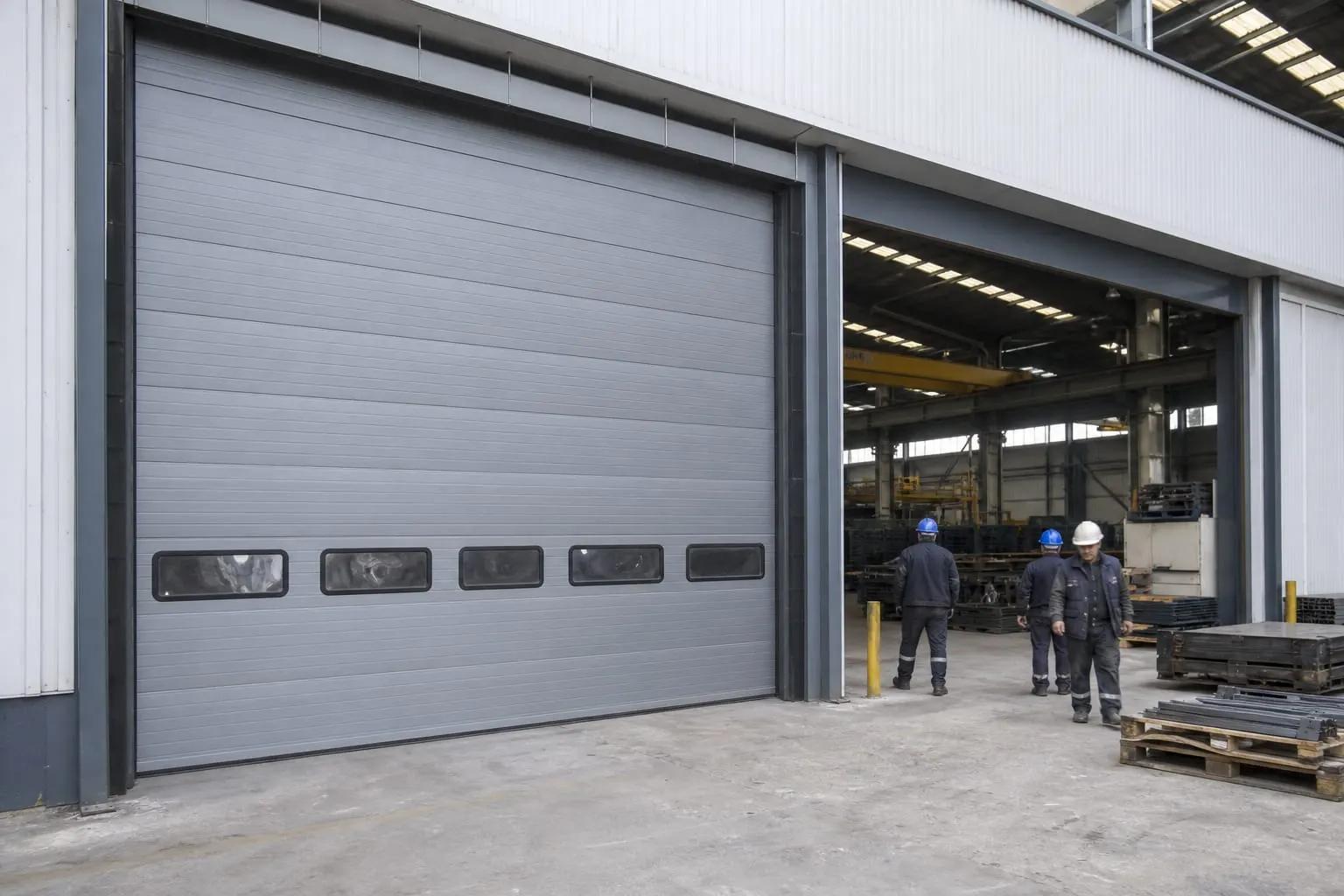
An industrial sectional door is a made-to-measure door system in which horizontal sandwich panels of galvanised steel and polyurethane foam open vertically and park under the ceiling. Because it is not an off-the-shelf product, its price is not standard either: a 3×3 metre warehouse door and a 7×6 metre logistics centre entrance may come from the same material family, but their panel count, motor power, track design and installation equipment are entirely different. This guide explains each cost item and lists the questions to ask when comparing quotes.
Why can't a sectional door price be given as a single figure?
The common "price per square metre" approach only gives a rough estimate. Square metres account for the panels, but the cost of a door is shaped just as much by the tracks, springs, motor and safety systems. On a small door, the motor and safety equipment make up a large share of the total; on a large door, the panels and supporting structure dominate. Prices quoted per square metre therefore become misleading as the size changes.
An accurate price comes from assessing the clear opening, the ceiling height, obstacles in front of and above the door (crane rails, services, ventilation ducts), frequency of use and the condition of the floor together.
How does door size affect cost?
As the size increases, it is not only the amount of panel that grows. The door becomes heavier, stronger torsion springs and a higher-torque motor are needed, and wide openings require panel reinforcement against wind load. Pack Door industrial sectional doors are made to measure up to 7500×6000 mm; on doors approaching this limit, the supporting structure and installation equipment become a significant part of the cost.
- Width: Determines panel length and wind load; wide doors need reinforcement profiles.
- Height: Determines the number of panels, track length and spring selection.
- Door weight: Directly affects the motor class and balancing system.
How do panel thickness and insulation affect the price?
The standard panel thickness is 42 mm; 60 mm panels are preferred where thermal insulation is critical. A thicker panel means more polyurethane fill and a heavier curtain, which affects both the panel cost and the choice of springs and motor. In cold stores and climate-controlled production areas, the extra cost of 60 mm panels can be recovered over time through lower energy loss. In an unheated warehouse, 42 mm panels meet most needs.
Seal quality is also part of the insulation. Missing or poor seals between panels, at the bottom and at the sides cancel out the advantage of a thicker panel.
Why does the lifting (track) type matter?
The lifting type determines how and where the door parks when it opens. Ceiling height and obstacles under the ceiling make this choice necessary. Pack Door applies 8 different lifting types:
- Standard lift: For most warehouses and factories with sufficient headroom.
- Low headroom: For buildings with limited space above the door.
- High lift: The track first rises vertically and then turns horizontal, so the door stays below cranes or services under the ceiling.
- Vertical lift: The panels park fully up along the wall, for buildings with very high ceilings.
- Inclined lift: For installations that follow a sloping roof line.
High lift and vertical lift require longer tracks, more fixings and a different spring calculation, so they cost more than standard lift. When requesting a quote, make sure the lifting type is stated clearly.
How do motor, controls and safety equipment change the price?
Industrial sectional doors are usually driven by a shaft-mounted industrial motor; for doors used only occasionally, manual chain operation is an option. As frequency of use rises, a more durable motor class is required. On the control side, push buttons, remote control, access cards or an interlock with a dock leveller add to the cost.
Safety equipment is the item that should never be negotiated away. Under EN 13241, the product standard for industrial doors, and EN 12453, the standard for the safety in use of power-operated doors, the following are expected:
- Spring break and cable break safety devices
- Photocell and bottom safety edge
- A means of manual opening in an emergency
Leaving this equipment out of a quote makes the price look lower, but it creates an occupational safety risk and costs more to add later.
How do options, colour and installation conditions affect the cost?
A wicket (pedestrian) door, window panels, full-vision panels and an air curtain are the most common options. Standard colours are RAL 9002, 9006 and 7016; the full RAL range can be applied for corporate colours, although non-standard colours may affect lead time and cost.
Installation conditions are often overlooked. Removing the existing door, whether the opening is steel or reinforced concrete, the need for additional steelwork around the door, the use of a platform or crane for high installations and the distance to the site all affect the total. Always ask whether these items are included in the quote.
Price factor summary table
| Factor | Effect on cost | Question to ask in the quote |
|---|---|---|
| Size | Determines panels, springs, motor and reinforcement | Was the clear opening measured on site? |
| Panel thickness | 60 mm panels cost more than 42 mm | What are the panel thickness and fill type? |
| Lifting type | High lift and vertical lift increase cost | Which lifting type was proposed, and why? |
| Motor and controls | Varies with frequency of use and automation level | What motor type and control options are included? |
| Safety equipment | Required by the standards | Are spring/cable break devices and a photocell included? |
| Options | Wicket door, windows and full vision are extras | Which options are included in the price? |
| Colour | Non-standard RAL may affect lead time and cost | Is the chosen colour standard? |
| Installation | Removal, steelwork and equipment are added | Are removal, installation and commissioning included? |
What should you look for when comparing quotes?
- Check that all quotes are based on the same size, panel thickness and lifting type.
- Make sure each safety device is listed individually.
- Check that the motor type and duty class are specified.
- Ask whether removal, installation, commissioning and training are included.
- Compare warranty cover, service response time and spare parts availability.
- Review the manufacturer's or installer's reference projects; you can see examples in our project gallery.
We took a similar evaluation approach in our article on factors affecting galvanised steel shutter prices. For the impact of sectional doors on logistics operations, see our logistics performance guide.
Frequently asked questions
Is a sectional door priced per square metre?
Square metres only give a rough estimate. The cost of the motor, springs, tracks, safety equipment and installation is not proportional to area, so the accurate price is fixed by an itemised quote prepared after measurement and a site survey.
Should you choose 42 mm or 60 mm panels?
In unheated warehouses and general-purpose areas, 42 mm panels meet most needs. In cold stores, climate-controlled production areas or facilities with high energy costs, 60 mm panels are the better choice.
Why is there a price difference between an industrial sectional door and a garage door?
Industrial doors are designed for larger sizes, more intensive use and heavier curtains, and the motor, springs and tracks are chosen accordingly. Residential decorative garage doors are intended for smaller sizes and less frequent use.
Is removal of the old door included in the price?
That depends on the quote. Removal, waste transport and any corrections needed to the opening may be separate items; ask about them explicitly when requesting a quote.
How long does delivery of a sectional door take?
Because it is made to measure, lead time depends on size, colour and options. Doors in standard colours with a standard lifting type are prepared faster than doors with special RAL colours or special lifting types.
Is a high-speed door or a sectional door more suitable?
If security and insulation on the external façade are the priority, a sectional door is the right choice; for internal passages that open and close very frequently, a high-speed PVC door is more suitable. Many facilities use both systems together.
Conclusion and next step
The price of a sectional door is not determined by size alone; it is the combination of panels, lifting type, motor, safety equipment, options and installation conditions. Comparing quotes item by item avoids offers that look cheaper but have a narrower scope. To decide on the right door size, panel and lifting type for your facility, request a free site survey; our technical team replies within an hour on average.